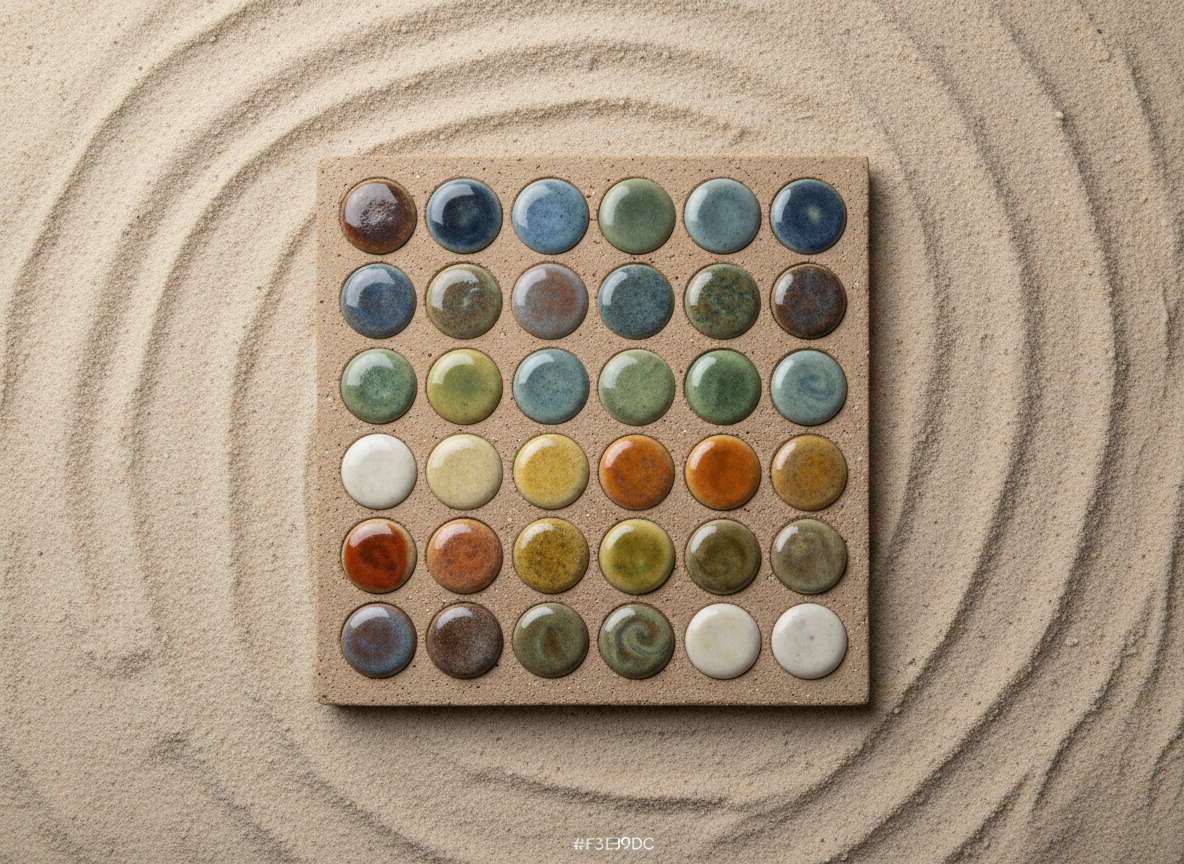
Glaze notes — salt, time, color
We favor glazes that age well with use—soft matte and satin finishes that deepen with time.
The chemistry of color
Glaze is essentially glass. When we brush or dip a piece in glaze, we’re applying a mixture of silica, flux, and colorants that will melt and fuse during firing. The final color depends on countless factors.
Iron oxide gives us our warm browns and tans. Cobalt provides deep blues. Copper can produce anything from turquoise to deep red depending on the atmosphere inside the kiln.
Salt firing
Some of our pieces are salt-fired—a technique where salt is introduced into the kiln at peak temperature. The sodium vaporizes and bonds with the silica in the clay body, creating a distinctive orange-peel texture that varies across every surface.
No two salt-fired pieces are identical. The side facing the flame receives more salt deposit than the sheltered side. We embrace these variations as marks of the process.
Testing and refining
Our studio shelves hold hundreds of small test tiles, each recording a specific combination of clay body, glaze recipe, and firing schedule. Some experiments yield immediate results; others take months of refinement.
Recently we’ve been exploring ash glazes made from wood ash collected from local orchards. The mineral content varies with each tree species, giving us a palette of subtle greens and grays.
Browse our current glazes in the shop and see how each catches the light differently.
Inspired by this piece?
Shop our collection